Fruits and Vegetables
Examples of 'Body - Tab WYSIWYG' and how it pairs with the 'Horizontal Rule' content type.
Fruits
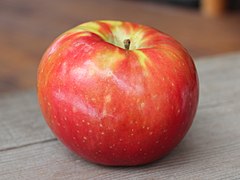
An apple is a round, edible produced by an apple tree (, among them the domestic or orchard apple; Malus domestica). Apple are worldwide and are the most widely grown species in the . The originated in , where its wild ancestor, , is still found. Apples have been grown for thousands of years in Asia and Europe and were introduced to North America by . Apples have and significance in many cultures, including , , and tradition.
An orange is a of various species in the (see ); it primarily refers to , which is also called sweet orange, to distinguish it from the related Citrus × aurantium, referred to as .
The orange is a between (Citrus maxima) and (Citrus reticulata). The , and therefore the maternal line, is that of pomelo. The sweet orange has had its full .

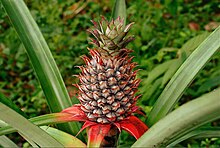
The pineapple is a , which grows to 1.0 to 1.5 m (3 ft 3 in to 4 ft 11 in) tall on average, although sometimes it can be taller. The plant has a short, stocky stem with tough, waxy leaves. When creating its fruit, it usually produces up to 200 flowers, although some large-fruited can exceed this. Once it flowers, the individual fruits of the flowers join together to create a . After the first fruit is produced, side shoots (called 'suckers' by commercial growers) are produced in the leaf axils of the main stem. These suckers may be removed for propagation, or left to produce additional fruits on the original plant. Commercially, suckers that appear around the base are cultivated.
The avocado (Persea americana) is a medium-sized, tree in the laurel family (). It is native to and was first domesticated in more than 5,000 years ago. as now it was prized for its large and unusually . The tree likely originated in the highlands bridging south-central Mexico and . Its fruit, sometimes also referred to as an alligator pear or avocado pear, is botanically a large containing a single large seed. Sequencing of its genome showed that the evolution of avocados was shaped by events and that commercial varieties have an origin.

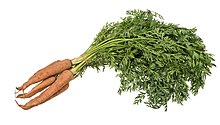
The carrot ( subsp. sativus) is a , typically orange in color, though heirloom variants including purple, black, red, white, and yellow exist, all of which are domesticated forms of the , Daucus carota, native to Europe and Southwestern Asia. The plant probably originated in and was originally cultivated for its leaves and seeds. The most commonly eaten part of the plant is the , although the stems and are also eaten. The domestic carrot has been for its enlarged, more palatable, less woody-textured taproot.
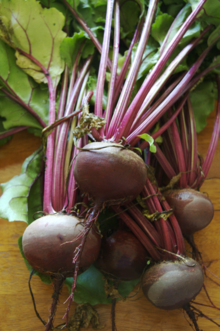
The beetroot is the portion of a , usually known in North America as beets while the vegetable is referred to as beetroot in British English, and also known as the table beet, garden beet, red beet, dinner beet or golden beet.
It is one of several cultivated varieties of grown for their edible taproots and (called beet greens); they have been as B. vulgaris subsp. vulgaris Conditiva .
Broccoli ( var. italica) is an edible green plant in the (family Brassicaceae, genus Brassica) whose large , and small associated are eaten as a . Broccoli is classified in the Italica of the species . Broccoli has large , usually dark green, arranged in a tree-like structure branching out from a thick which is usually light green. The mass of flower heads is surrounded by leaves. Broccoli resembles , which is a different but closely related cultivar group of the same Brassica species.

Cauliflower is one of several vegetables cultivated from the species in the genus , which is in the (or mustard) family.
An that reproduces by seed, the cauliflower head is composed of a white . Cauliflower heads resemble those in , which differs in having flower buds as the edible portion.
